The stone circles of Machrie Moor
Six circles in sandstone and granite make Machrie Moor more than a set of old stones: the ground holds traces of earlier building and burial.
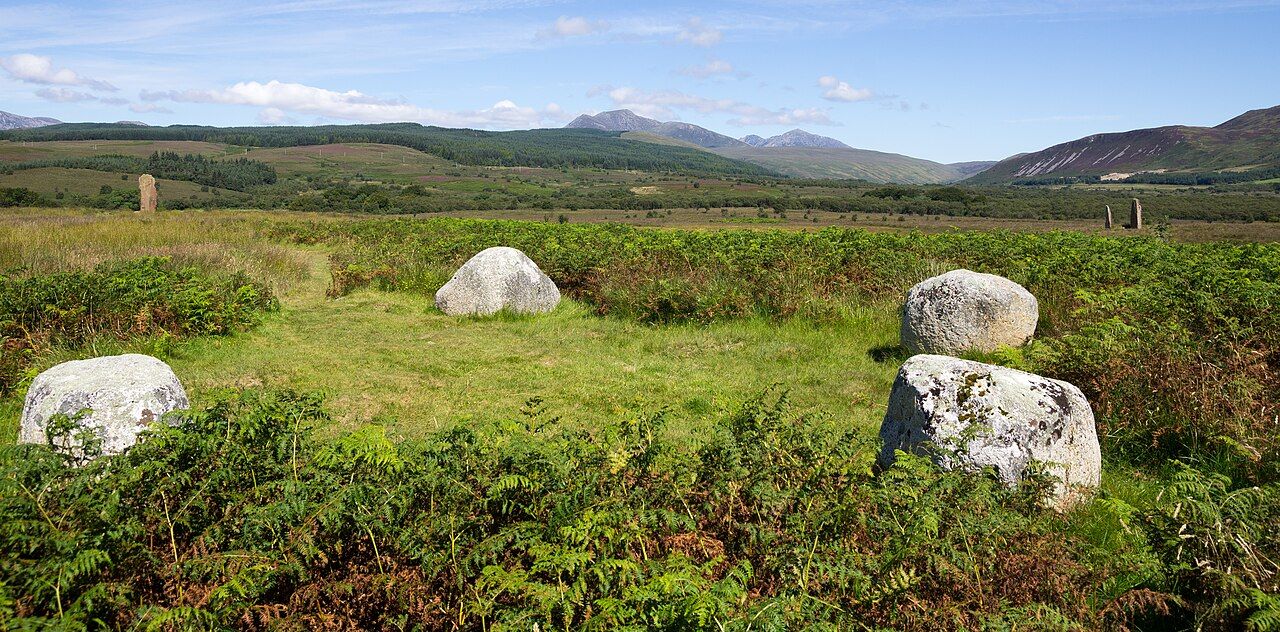
My sister hates hills, so I tend to ask the question she would ask of a place like this: are the stones worth the effort of looking closely? At Machrie Moor, I think they are. Not because six circles make a grand spectacle, but because their differences resist a simple answer.
The circles matter less as a collection of objects than as evidence of a place repeatedly shaped for use.
The circles matter less as a collection of objects than as evidence of a place repeatedly shaped for use.
What is Machrie Moor?
On the west side of Arran, Machrie Moor holds the remains of six stone circles. Some are made from tall red sandstone slabs; others from rounded granite boulders. That contrast is the first thing I would hold on to. The circles are not a uniform set, and the different stones make the moor harder to reduce to a single image.
There is a tendency to treat a circle of stones as a complete statement: a neat shape, a clear purpose, an object to be understood at a glance. Machrie Moor offers something less tidy. Its remains invite attention, but they do not explain themselves.
How old are the circles?
The Machrie Moor circles were built in the Neolithic and Bronze Age, roughly between 3500 and 1500 BC. That is a broad span, not one moment of construction. It matters, because the six circles should not be treated as if they were all made together or meant exactly the same thing.
The dates give a sense of duration without supplying a full story. What can be said directly is that the stones belong to a long stretch of the island’s past. Beyond that, certainty would be misplaced. The gap between knowing when they were built and knowing what every circle meant is part of the interest.
Why do the stones look so different?
Some circles use tall red sandstone slabs; others use rounded granite boulders. The variety is not a minor detail. It changes the character of each circle, from upright slabs that assert their height to boulders whose shape feels less controlled. That is an impression, rather than an explanation of why people chose one material over another.
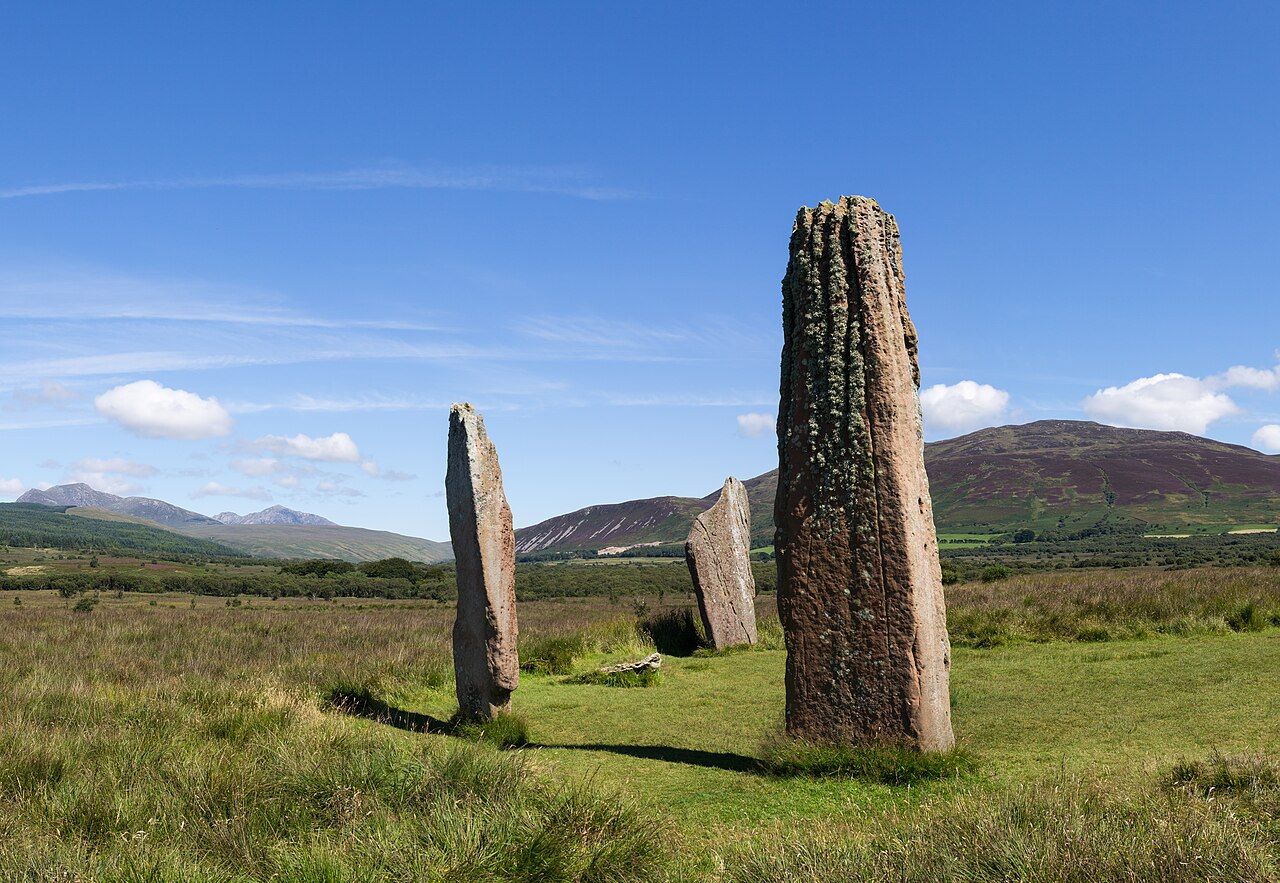

The tallest standing stone on Machrie Moor is over 5 m high. It gives scale to the place, but height alone is not the point. A striking stone can draw the eye; the wider group is more compelling because the materials and forms do not settle into one repeated design. The contrast has a useful echo in a double ring of granite boulders.
Were there buildings here before the stones?
Excavations found that timber circles stood on some of the sites before the stones. This is one of the more persuasive details at Machrie Moor: the circles were not simply placed on an untouched surface. At some sites, one form of building came before another, and the stone remains belong to a longer sequence of activity.
That does not tell us precisely why the timber circles were replaced, or whether the change meant the same thing at every site. It does make the familiar image of a single act of construction feel inadequate. The stones are part of a history with earlier layers, not the whole account.
What does the peat conceal?
Peat began to cover Machrie Moor after the circles were built. It buried older field walls and hut circles. That fact shifts the view beyond the visible stones: the moor contains traces of other structures, some covered over by the growth of peat.
I find this more interesting than a claim that the circles stand alone. They occupy a landscape with evidence of other activity, though the buried remains do not give us a complete picture. Peat is not merely a backdrop here. It has changed what can be seen, and made the ground itself part of the story.
Were the circles used for burial?
Several of the circles once had burial cists at their centre. This is a solid reason to resist treating them as decorative arrangements, but it does not prove that every circle had the same role. Nor does it settle what the stones meant to the people who built them.
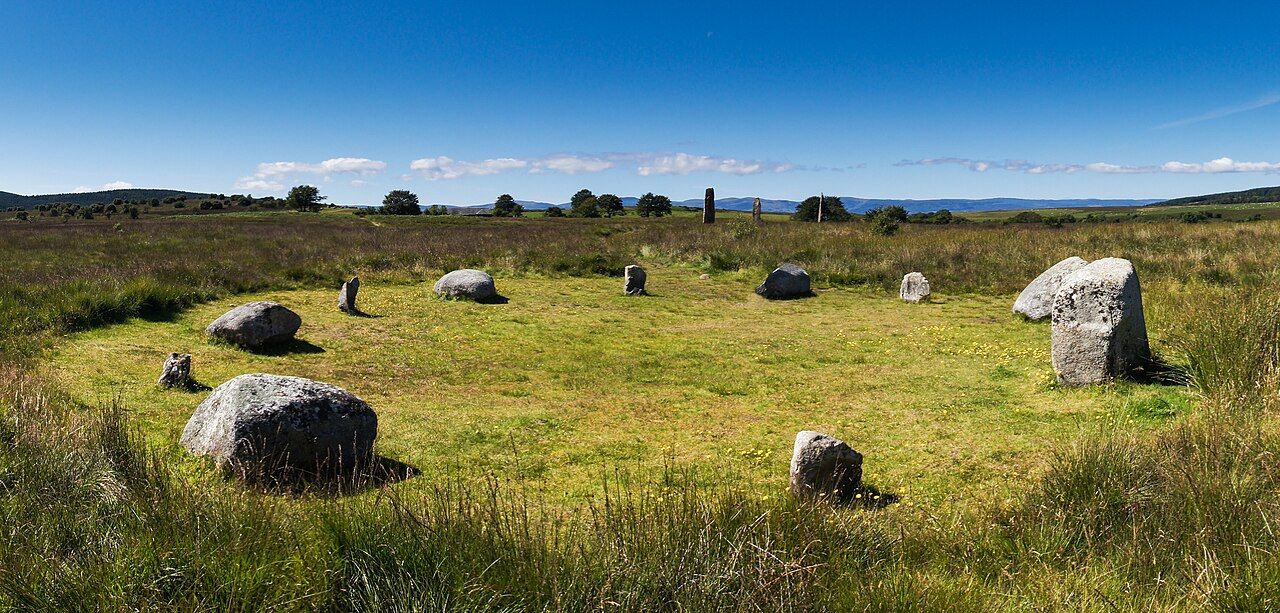

The burial cists add weight to the central spaces. They also complicate the easy reading of a circle as a shape with one clear purpose. A place can carry more than one meaning over time; here, the evidence supports burial at several centres, while leaving the wider interpretation open.
How should the place be read?
By keeping separate what is known and what is tempting to imagine. The dates, the different stones, the earlier timber circles, the peat-covered walls and hut circles, and the burial cists give plenty to consider. They do not amount to a complete account of the people who made or used the sites.
The strongest response is not to force a tidy explanation. Machrie Moor earns attention through the layers that remain visible and those that have been covered. The circles are striking, but their uncertainties are more lasting than any single theory about them.
Is Machrie Moor part of a wider story?
It is reasonable to set the circles beside other traces of the past on Arran, without pretending that they all tell the same story. A comparison might include another Neolithic tomb in the south. The value is not in making every place interchangeable; it is in noticing how much remains to be interpreted.
The island’s landscape also invites thoughts beyond the circles, including the empty glen to the north. But Machrie Moor is best judged on its own evidence: six circles, varied stone, traces beneath the surface, and signs of use extending beyond the visible monuments. The circles are in the care of the state heritage body for Scotland.
What stays with me?
Not a single view, or a claim to have solved the place. It is the mismatch between the clean outline of a circle and the untidy history around it: timber before stone at some sites, burial cists at several centres, and older field walls and hut circles beneath peat.
That is enough to make Machrie Moor worth taking seriously. The stones are not a complete answer, and they are more interesting for it. How much of the story is still under the peat?