Fingal's Cauldron Seat: a stone with a story
A holed boulder at Machrie Moor carries the story of Fingal, Bran and a cauldron, within a circle of two granite rings.
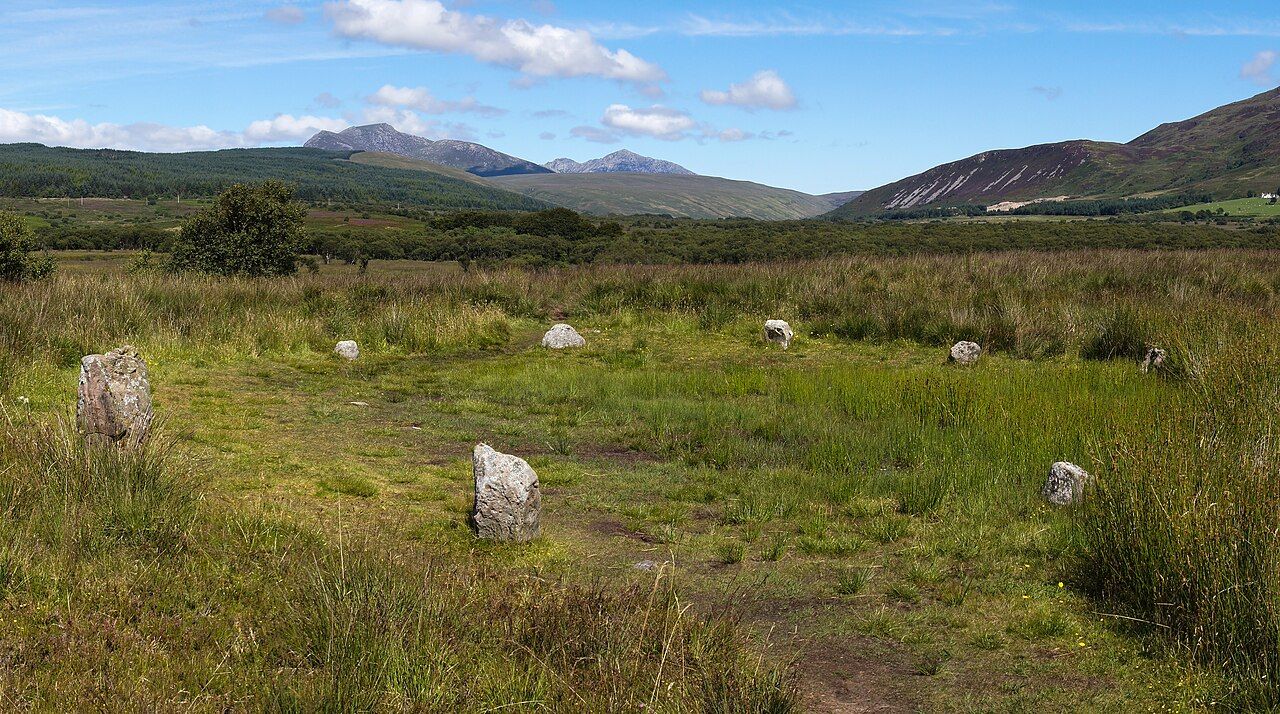
What gives one stone the power to hold a whole story? At Fingal's Cauldron Seat, the answer is a hole through a boulder, and the legend attached to it.
The circle is made of two concentric rings of rounded granite boulders. The inner ring has eight stones; the outer has fifteen. Among the Machrie Moor circles, its stones retain their form particularly clearly, but the count is not what makes it linger in the mind. The holed stone does that.
The boulders were brought down from the northern hills by ice. Their rounded forms belong to the land’s long history, while the hole draws the eye towards a much more particular tale. A local legend says that the giant Fingal tied his dog Bran to the stone while he cooked in his cauldron.
It is a good story for a single boulder: simple, vivid, and easy to remember. It also makes the circle feel less like a pattern to inspect than a place where somebody has left a detail for the imagination to work on. The story does not explain the stones. It gives one of them a role.
Fingal is the island name for Fionn mac Cumhaill, a hero of Gaelic legend in Scotland and Ireland. That name reaches beyond the circle, towards the old names on the map and another place of island legend. The wider setting matters, but it is the hole that makes this circle distinct.
Across the moor, the tall sandstone stones of neighbouring circles are visible. They offer a different kind of presence: a clear contrast with the rounded granite at Fingal's Cauldron Seat. The circle belongs among the six circles of the moor, though its best detail is singular.
The legend is not proof of what happened here; it is a way of looking at one stone and seeing more than a hole. Is that enough to make Fingal's Cauldron Seat the circle that stays in mind?