The northern granite and how it rose
Arran’s northern mountains are granite formed deep underground, then lifted into a dome and shaped by ice and weathering. The story begins beneath the ridges.
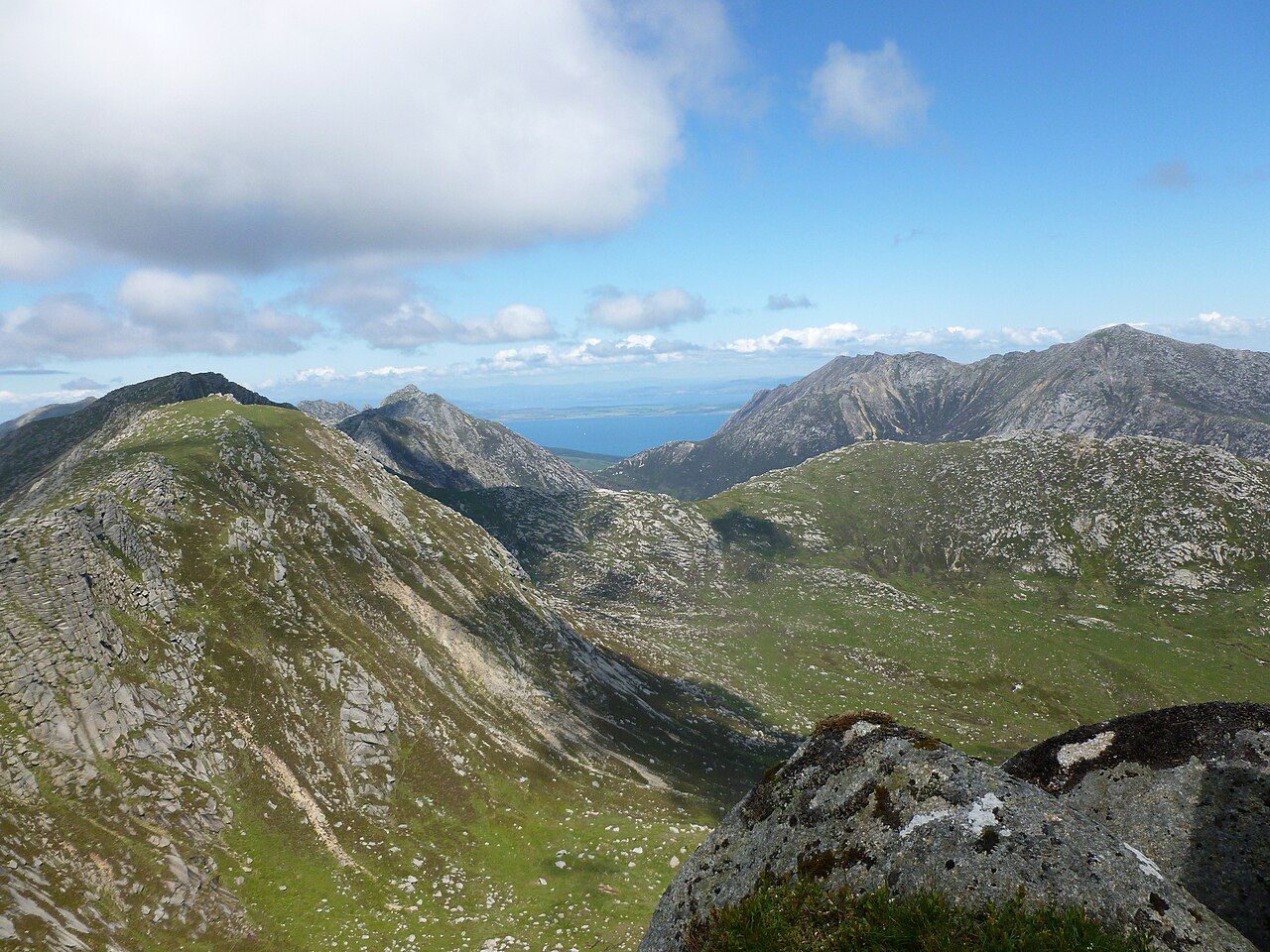
A boot meets granite; the eye goes to the ridge, but the more interesting story starts underfoot. The northern mountains are made of this rock, and their shape is part of a longer account: molten granite cooled below ground, pushed up older rocks, then met ice and weathering.
What is the rock beneath the northern mountains?
It is granite, formed about 58 to 60 million years ago. That makes it the central subject here, not a detail to glance past on the way to a summit. The land above gives the rock a grand outline, but the granite itself has a history that can be read in its grain, its joints and the blocks it weathers into.
The rock underfoot is not background; it is the start of the whole account.
The rock underfoot is not background; it is the start of the whole account.
How did the granite form?
The Arran northern granite was intruded as molten rock and cooled slowly below ground. “Intruded” is the useful word: the granite entered the older rocks while molten, rather than being laid down as a surface layer. Its eventual mountains were not simply there from the beginning. The rock formed beneath the ground, and the land’s present shape came through later movement and carving.
This is a satisfying story because it makes the mountain mass feel less like a fixed object and more like the result of several distinct processes. First the molten rock cooled; then the surrounding rocks were raised and tilted; later, ice and glaciers cut into the granite.
What did the rising granite do to the older rocks?
As the granite rose, it pushed up and tilted the older rocks around it into a dome. That gives the northern granite a structural role: it did not only make the mountains themselves, but altered the rocks around its edges. The dome is a more useful way to picture this than imagining a simple pile of granite sitting on top of everything else.
The granite forms a roughly circular mass about 12 to 14 km across. “Roughly” matters. This is a broad description of its shape, not a claim that the edge makes a perfect circle. The scale is substantial enough to explain why the granite belongs to the whole northern mountain country, rather than to one isolated peak.

Is all the granite the same?
No. The outer granite is coarse-grained, while the inner granite is finer. That contrast is one of the clearest ways to think about variation within the mass. It is still granite throughout, but the texture is not uniform from edge to centre.
There is no need to turn this into a test for the walker. It is enough to know that “granite” does not mean one identical surface everywhere. The outer and inner parts differ in grain, and that difference adds another layer to a landscape which can otherwise seem defined only by its broad ridges and steep sides.
Why are there tors?
Granite on Arran weathers along joints into blocky tors and coarse gravel. The joints give the weathering its lines; the result is not a smooth, even wearing down, but blocks and broken material. That is why granite can look so emphatically divided, with solid forms beside loose, coarse fragments.
The the castle-like tors make this character especially easy to notice. Their shape is the sort of feature that can draw the eye away from the underlying process, but the process is the better story: weathering follows joints in the granite, leaving blocky forms behind.
What shaped the corries, ridges and glens?
Ice sheets and glaciers later carved the granite into the corries, ridges and glens seen today. The rock’s formation and the land’s carving belong to different stages of the account. The granite formed underground; ice and glaciers then cut the forms that give the northern hills much of their present character.
a glacier-cut valley is a useful place to hold those ideas together. The valley is not the original shape of the molten rock; it belongs to the later work of ice. The distinction matters. It keeps the explanation from making the granite responsible for every feature in the landscape.

Why does the granite make such strong ridges?
The facts here are simpler than some grand descriptions of mountain scenery. The granite forms a broad mass; ice and glaciers carved it into ridges and glens; weathering along joints makes tors and coarse gravel. That is enough to explain why the rock underfoot and the larger forms above it belong in the same story.
the climbers' granite buttress is a particularly direct expression of that connection: granite is not only the material beneath a view, but a visible mass with its own shape. I prefer this kind of explanation to treating a striking outline as if it were self-explanatory. A ridge becomes more interesting when the rock and the forces acting on it are both in view.
Where else can the granite be found?
Rounded granite boulders carried by ice from the northern hills are scattered across the south of the island. They make the reach of the ice legible beyond the mountains themselves. The boulders are not a separate kind of story: they connect the northern granite to the wider island, carried away from the hills by ice.
That is a pleasing counterpoint to the tors. In the north, weathering along joints leaves blocky forms and gravel; farther south, ice-carried boulders are rounded. The same granite appears in different shapes, shaped by different processes. It is a better ending to the account than a claim that the mountains are only a view.
Was Arran’s granite part of something larger?
It formed at the same time as the volcanic centres of Mull, Skye and Ardnamurchan. That places Arran’s northern granite alongside a wider group of formations, without taking anything away from its local character. The dome of older rocks, the contrast between coarse outer granite and finer inner granite, and the tors remain specific features of the Arran story.
The northern hills are therefore worth looking at twice: first for their outline, then for the granite that made it and the changes that shaped it. The island’s stones carry the explanation more plainly than any grand account of scenery could.