Counting the dykes at Kildonan
A shore marked by dark walls and trenches, where Arran’s volcanic history is unusually easy to read in the rock beneath the eye.
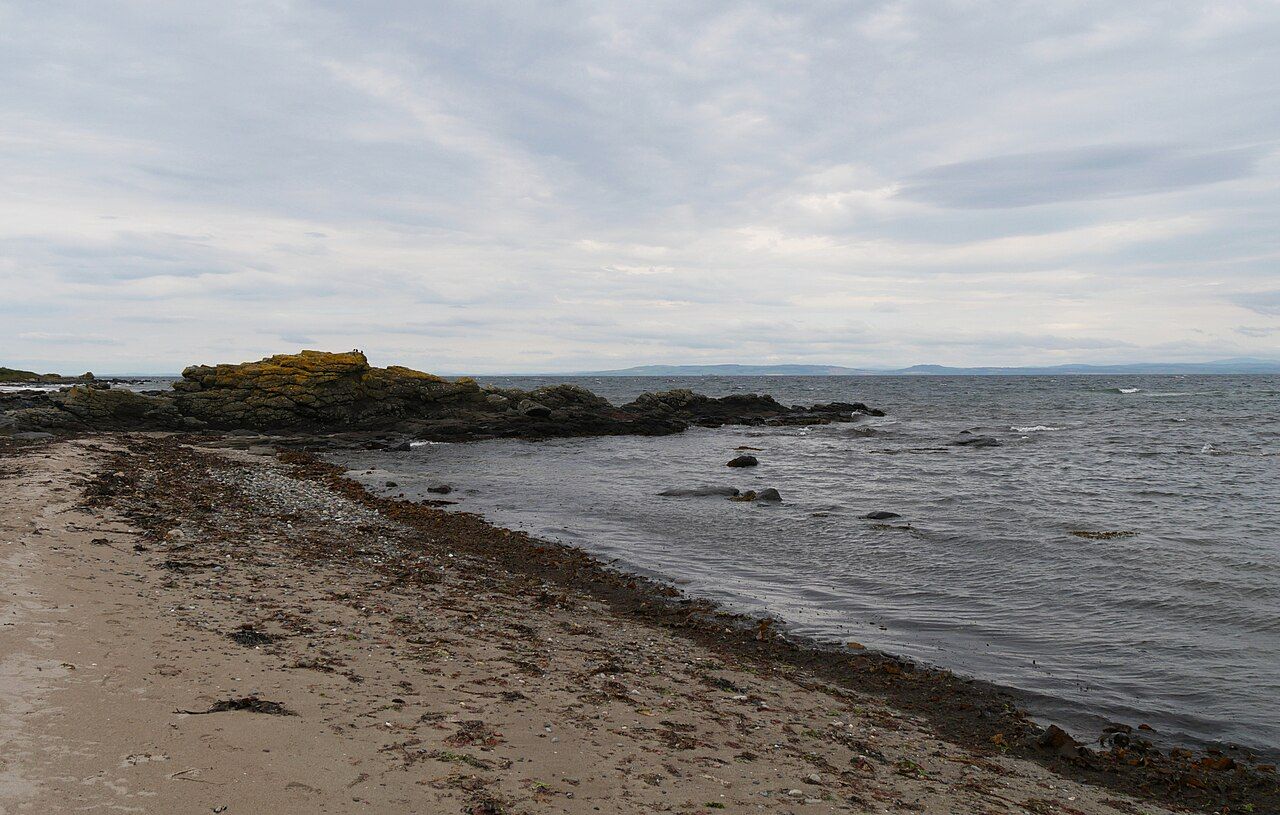
What is worth looking for on the Kildonan shore? The answer is not a single landmark, but a pattern: dark walls of rock cutting across older layers, with trenches where other dykes have weathered away. This is a good stretch of coast for counting the evidence rather than trying to take it all in at once.
A dyke is a near-vertical sheet of igneous rock, forced across older layers while molten. Around Kildonan, on the south coast of Arran, the concentration is among the densest groups of dykes in Britain. The scale of the swarm matters, but so does its legibility. Some dykes remain as low walls; others have become trenches. The difference makes the geology easier to notice.
The south-coast dykes belong to a swarm formed about 60 million years ago. Most of Arran’s dykes run north-west to south-east, giving the group a prevailing direction without making every section of shore look alike. Many here are dark basalt or dolerite. Against the older layers, their crossing lines are the main event.
There is a pleasing directness to this kind of geology. The rock does not need a grand claim attached to it: the walls and cuts show what happened, and the repeated pattern rewards a slower look. The village above the shore, the village above the shore, gives the place its name, but the interest is at the level of each exposed dyke. Count them, and the shore begins to feel less like a collection of dark marks than a record of force moving through older rock.
The dyke swarm is linked to the same period of volcanic activity that formed Arran’s granite. That connection gives the shore a wider scale, though the dykes themselves remain the more immediate subject. Pladda, the low island off Kildonan, is formed of a sill of igneous rock: the low island of Pladda adds another form of intrusion to the view. It is a useful contrast with the columned sill of the west. Arran’s rock story has another chapter too.
Kildonan is not simply a place to leave behind in favour of a broader view. The case for stopping is the pattern itself: a dense swarm, clear in its direction and varied in its weathering. The shore’s repeated dark lines are reason enough to pause.