Hutton’s unconformity at Newton Point
At Lochranza, a meeting of younger sandstone and tilted older schist gave James Hutton evidence for an Earth far older than most people then believed.
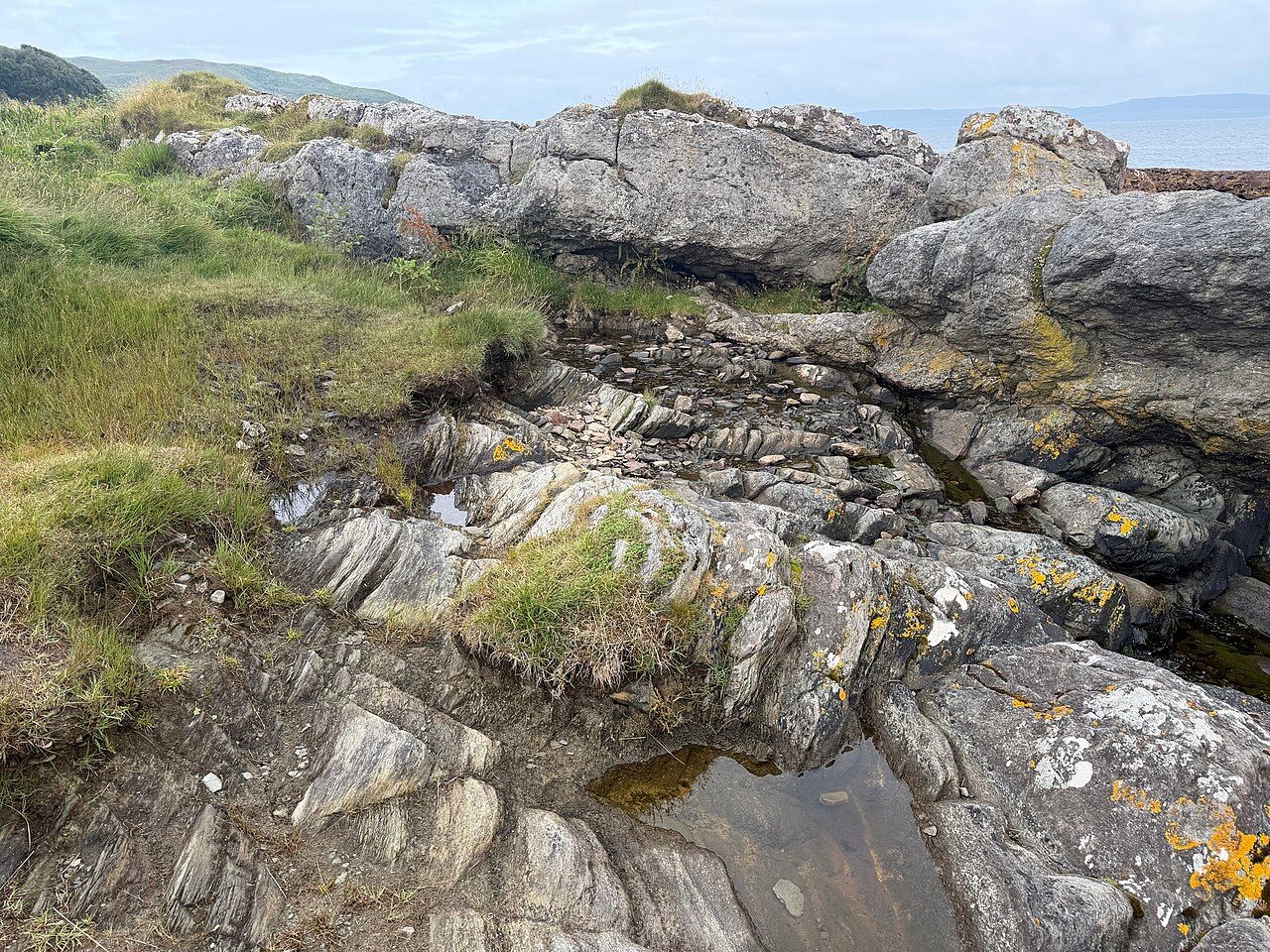
In 1787, James Hutton, the Edinburgh geologist, visited Arran. Near Newton Point on the north shore of Loch Ranza, he saw younger sandstone lying across steeply tilted older schist. The encounter is a compact story with a large consequence: a visible junction helped him argue that the Earth was far older than most people then believed.
What is the outcrop?
It is a place where two very different sets of rocks meet. The older rocks are Dalradian schists, hundreds of millions of years old. Above them lie younger Carboniferous sandstones and cornstones. The older rock is tilted; the sandstone lies across it.
A junction where younger rocks rest on eroded older rocks is called an unconformity. The name can sound abstract, but the arrangement is not. One set of rocks has been tilted and eroded; another lies across it. The contact makes the difference in age and position hard to ignore.
The importance is not the angle alone, but the argument it made possible.
The importance is not the angle alone, but the argument it made possible.
Why did Hutton care?
Hutton used unconformities to argue that the Earth was far older than most people then believed. Here, the older schist had to be in place, tilted and eroded before the younger rocks could rest on it. That sequence carries a sense of deep time without needing a grand display or a long explanation. The evidence is in the relationship between the layers.
That is what makes the site more than a meeting of rock types. The outcrop gave Hutton something he could point to: an older surface, altered and worn, with younger stone laid across it. His argument depended on reading that difference as a record of time. It is a persuasive piece of geological reasoning, and the scale of the conclusion is striking beside the smallness of the observation.
Was this Hutton’s famous unconformity?
It was his first. Hutton found the unconformity at Lochranza a year before his better-known find at Siccar Point in 1788. The later discovery is better known, but Lochranza has the stronger claim to being the beginning of this particular line of evidence.
That distinction is worth keeping. It is easy for the famous name to take over the story, leaving the first find as a footnote. At Newton Point, the appeal is precisely that this was the earlier encounter: an outcrop on Arran that helped Hutton make an argument he would also pursue elsewhere.
What should the eye look for?
The key is the contrast between the steeply tilted older schist and the younger sandstone lying across it. The word “unconformity” describes the junction, not a separate kind of stone. The rocks matter, but so does their arrangement. Without that crossing relationship, the story would be less clear.
There is no need to turn the place into a grand spectacle. Its interest lies in a specific meeting of older and younger material, and in what that meeting allowed Hutton to argue. I prefer that kind of evidence to a claim that a site is important merely because it has a famous name.
Does the outcrop stand alone?
Arran’s wider geology gives the site a useful setting. The British Geological Survey describes Arran as a place where a wide range of rocks can be seen in a small area. That makes Hutton’s unconformity part of a broader island story, without taking anything away from the particular evidence at Newton Point. For another strand of that picture, there is the great fault that crosses the north.
Other parts of the island’s geology have their own stories, including the island's raised shorelines.
Is the site easy to understand?
The word is the hardest part. An unconformity is simply a junction where younger rocks rest on eroded older rocks. Once that is clear, the interest becomes quite direct: the schist is older, the sandstone and cornstones are younger, and the surface between them belongs to a sequence of events that Hutton used to think about the age of the Earth.
The outcrop lies on the shore near the village by the loch, but its importance is not a matter of scale or drama. It is a precise piece of evidence. The village setting and the geology can sit alongside one another without either needing to be dressed up.
What is the verdict?
Hutton’s unconformity at Lochranza earns attention because the reasoning remains legible. Younger rock crosses older, tilted rock; the contact records erosion; and Hutton used such evidence to argue for an Earth of immense age. The outcrop does not need a more theatrical claim than that.
It is also a useful correction to the habit of remembering only the better-known discovery at Siccar Point. The first find was here, at Newton Point. For a small stretch of shore, that is a substantial place in the history of science.